Showing posts with label Amy. Show all posts

Thursday, December 31, 2009

The Top Ten

Here's our list of the top ten artists at Fifty Two Pieces and the pages that made them so popular. Like most popularity lists this one is skewed by length of time a page has been circulating on the internet. Although Raphael and La Donna Velata made the cut it was just barely. However, Raphael only first appeared during the last week of October. Part of the reason Josef Sudek is a front runner in popularity has to do with the world wide audience Fifty Two Pieces has. Visitors come from all over the world and make frequent revisits. Although most of the over 17,000 visitors are from the United States, Canada and Great Britain, people from over 100 countries have dropped in on Fifty Two Pieces.

Check out these artists and the other 42 that we have presented in the last year. For each one on the Top Ten List we've also included a link to all of their posts.


Amy had this to say today...
My personal favorite, the artist I most enjoyed learning about this year, is you LaValle. This project taught me so much about partnership in writing and learning. It has been invaluable for me. I have logged into Fifty Two Pieces for the last time and no new years resolution will ever be the same.

LaValle had this to say on this last day of 2009...
Starting tomorrow, I'll no longer be thinking about what I'll be writing about on Fifty Two Pieces, nor will I be researching what that writing will be about, nor will I be waking up early to actually write it. Not doing all of that in turn will be leaving hours of extra time every day. What is she going to do you might ask? Voice from the Couch is also waiting to hear and not too patiently for that answer.

Well, I'll be starting a photography blog Portland Through My Lens. I'm challenging myself to ride the Portland Streetcar every day of 2010 and take photographs and post at least one of those images. The restrictions I'm imposing on myself are that the photos must be either from the streetcar or within two blocks of the streetcar. And I should amend the challenge to everyday that I'm in Portland since I do hope to travel sometime during the year. I'll have to come up with a sub-challenge for those days.

2009 has been a fine year, full of lots of planning, website maintenance and many discoveries. Thank you Amy for a great year. And thank you to everyone, all 17,000+ visitors, who have helped to make the year as good as it was.

Monday, December 21, 2009

Dan Flavin's Light in Tadao Ando's Vessel

In an interview in December of 2007 Steve Morse told Matthias Waschek that as curator of the Flavin retrospective at the Pulitzer, in the world renowned architect Tadao Ando's building, he was not creating Flavin's work but rather acting as translator who spoke Flavin's language.
What a wonderful description of a curator's role in the process, and what a great first question for an interview.
I'm sure we all have our opinions about what makes this work. Does the light make the work? Does the curator make the work? Does the artist make the work? This is like owning an idea, does anyone really own an idea? Flavin's work feels like ideas. They feel open and free, like they don't belong to anyone. Flavin's retrospective required curators to apply his light to another artists' light, Tadao Ando. This was a thoughtful pairing, I'm sure, because these are two connoiseurs.
I had the opportunity to visit Ando's new building at the Clark Art Institute earlier this year and was blown away. The light of an Ando building is so present, so much a part of the space, it felt heavenly in its simplicity. To add to one of his buildings dozens of Flavin light sculptures must have been just phenomenal. Phenomenal for Flavin fans, but what about Ando?
Flavin's florescent surely cast a glare on Ando's use of natural light and ability to capture it so seductively. Could one still feel what the sun and shadows were doing to those walls during the Flavin exhibition? Whether a museum is a sculpture or not, it is there to house objects, and I'm sure Ando was proud to see his creation full of Flavins'. But Ando's buildings are sublime and complete, so if I were only to see this one once I don't know that I would want to see it full of Flavins. Then again, who else could make an Ando glow so brightly?
To see more about the exhibition check out this amazing web catalogue.

Friday, December 18, 2009

Dan Flavin in the Corner

I cannot believe it is week 51 already. One week left. We've almost made it for an entire year- here is a good dance to represent how that makes me feel:

But if you want a little more serious Flavin education, watch this:

And how does this make me feel?
Makes me feel like my New Year's Resolution for 2010, to give away at least one thing every day, is a good one. Why? Because my husband says if I give away 365 things I won't have anything left.
Flavin says, you go girl.

Sunday, December 13, 2009

Camping in the Cascades

By: Joseph Powell

Hungry for bootprints, shades of differences,
we've come to think like the earth.
In the valley below, it was summer,
dim air-conditioned houses sulked,
days flat as fallow fields.
We climb back in time:
yellow fawn lillies, shooting stars,
ferns curled tight as snails.

We meet grimed climbers coming down,
each wrapped in a heavy calm
that bears the unsteady weight of each foot.
Out of the blue, one mountain
after another steps forward, beckoning.
How far can we go?
Finally at Deep Lake, other tents
scattered along the shore,
we eat and watch a half moon rise.
The stars that guided seafarers,
kings, whole milleniums of geese,
awaken slowly in uninterrupted sky.

Our lives shrink to incandescent flames
that blink on the surface of the lake.
Smoke climbs its rope of air
and disappears into the dark
like our own best thoughts.
Nocturnal eyes open, claws flex.
Faithfully, we lie on the ground
spinning slowly through space.
Heavenly bodies shine through our sleep.

Happy Birthday LaValle, you brilliant burst of light!

Sunday, December 6, 2009

Chess and Conversation

My dad taught all of his children to play Chess when we were very young. We played each other and we played him, many, many times. He rarely went out, but when he did it was over to Dubersich's house for a game of Chess. One game took hours as they were rightly matched.
I know how to play Chess, but I never do. My last wonderful Chess moment happened five or six years ago when I challenged a good friend's beau to a match. This is the kind of guy that whips out a complete New York Times crossword in fifteen minutes, the kinda guy who can spend twenty minutes silently petting the cat and half an hour at a garage sale looking at records, but can't handle five minutes of small talk, and doesn't think he should have to. I didn't think I stood a chance against him but knew I had to win. He didn't know I had it in me, which worked to my advantage, I kicked his ass. It felt sweet like victory should.
Chess is not an easy game to play or win which is why everyone should know the game, it's a lot like life.
Duchamps suitcases are a lot like life too. Boxes full of compartments like little houses full of rooms, each one stuffed with reproductions of other things, toilets, art, vases all in miniature. The boxes are carefully constructed, like little houses, one after the other.
I can imagine Duchamp and his wife, the two of them cutting out the pieces. Maybe they went back and forth in conversation the way players at chess go back and forth taking turns harrassing the other with a move well played, like words well spoken. In Chess it is discouraging to your opponent both your good strategy and your thoughtless move. As in conversation, where both parties rely on thoughtful participation, if one strays down a random course unrelating she may leave the build up of the topic and the conversation will likely end. In Chess if you don't pay attention or think you have something completely different in mind, you may fall to your death in one false move.
In both cases unless the other player is made to follow his opponent's idea or is able to pull him back to his own course, the game will end. The better conversation and the better Chess game are almost always those that last longer. In either case, to make this work, each participant must always be thinking simultaneously about what is happening at that very moment and the thing which he is surely missing and attempt to find it before it finds him. And a good player understands where it is she is going without knowing all the moves that will get her there until she has to make them. She must make them at just the right moment.
The longer the conversation, the longer the Chess game, the longer the trip. We all agree we would like to have the longest trip here as possible, as long as it's a good one. Duchamp clearly agrees, as each valise takes a while to unpack.

Monday, November 30, 2009

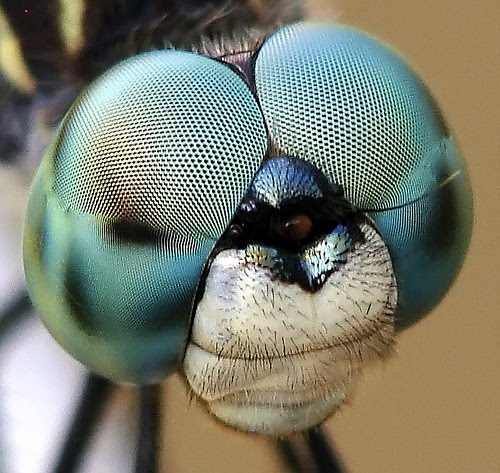
Fly Eye and the Amazing Hexagonal Mirror


Being with Hexagonal Mirror makes me appreciate the eye of the fly- if you were to push the thing in from behind that's what you would get, one giant insect eye. In this case I am the insect, seeing the world around me in thousands of tiny mirrors.
I see all these pieces of me separated from each other. In one mirror is my mouth and there it is again and again, dozens of my mouths in little seperated compartments populate one area of the mirror.
Even more wonderful than my closed mouth in forty mirrors is the echo I get when I stand in the sweet spot. It vibrates off the walls of the Hexagonal Mirror. So I stand within the tiny reflected pieces of me and make the biggest noises I can make. The noises get bigger than I can make them because they bounce off the walls. I am made bigger and smaller in this place, and everything about me is multiplied.
LaValle is right about entering a new world, this piece of art is a world with it's very own version of every person that enters it. It has it's own silent sound system just waiting to be turned on, the only thing about it that reminds me of the world I know is that it looks like a fly eye, and really, what is more amazing than that?

Tuesday, November 24, 2009

At The Met with Eve and Florine

Last week I went to the Met with my Aunt Eve. Eve lives in New York, I grew up in a tiny Oregon town. I thought of her often and how someday I would visit her in the Big Apple- imagining a city as ripe and sweet as something that grew on the trees outside our house. I thought I would go the day I graduated from high school, but until last week I had never visited Eve. She's painted all the walls in her house, and her fireplace and shutters. She says this is the fourth time she has re-primed and painted the hearth:

We went to the Met, she wore at least a dozen colors and I was head to toe in black, she threw a crazy scark of me, so we would match. We wandered for hours, until we came to the Stettheimer wall:

I read the wall panel for my favorite of Florine's paintings, The Cathedrals of Fifth Avenue:

Wall Panel: In each of her Cathedrals, Stettheimer uses architecture to organize her composition. In this case it resembles a real Cathedral, perhaps Saint Patrick's Church on Fifth Avenue, although the newlyweds emerge from underneath a bright red canopy and matching carpet that seem to belong more to the Plaza Hotel than to a church. All around this central scene, activities depicting other aspects of conspicuous consumption abound, seemingly unaware of the wedding taking place. This wild activity energizes the canvas just as it energizes Fifth Avenue on a Saturday afternoon in December.
I didn't say anything, and neither did Eve. We just looked. For a long time.
Later I was thinking about the painting, we were sitting on the couch together.

I said, remember that big painting with all the colors, on the wall- there were four of them- they were street scenes of New York. She nodded. I said, I think I would like to write about those for my blog this week. She frowned, I didn't like those paintings she said. Why? I asked. There was nothing I could find to like about those, but I loved the frames.

Sunday, November 15, 2009

Like a Ship at Sea, The Mirage of an Arabian City

There is something so wonderfully feminine, loose and liquid about Frankenthaler's work. It is like air and water and dripping cracked eggs. Her paintings are boundary-less, there are no hard edges, just endings to colors that become other colors. The pink of Spaced Out Orbit has a quality so vast, as if it is a city floating out in front of me, far away. Or a ship on the sea. Wherever it is, it carries it's own atmosphere. What I love about Spaces Out Orbit is that Frankenthaler knew when to stop. It is a skill to not go too far, and for her to have left so much empty space and to have known the delicate balance of completion, shows her intuitive wisdom. She often covered her canvases head to toe, take a look.
Here is "Seeing the Moon on a Hot Summer Day" done in 1987. Beautiful, amazing, but full. Or check out the one below, "May 26th Backwards" done in 1961. That's my birthday.

From the same website where I pulled these images, I found these Frankenthaler quotes.

"I had the landscape in my arms as I painted it. I had the landscape in my mind and shoulder and wrist."

"Every canvas is a journey all its own."

It is almost like birth, her paintings. It is almost like she is giving life to something that was already there, and she knows it.

Saturday, November 14, 2009

Space Cloud, Mirah's Serenade

Today I will be writing about the local singer and songwriter, Mirah. Watch this clip of her with the Portland Cello Project, from January of this year:

Mirah, Portland Cello Project & Flash Choir - Generosity from Jon Manning on Vimeo.


Frankenthaler's Spaced Out Orbit became the inspiration to a Mirah song in September at the museum's event Shine A Light. The Museum invited the PSU Social Practice Program to have an event inviting a new and young crowd to the museum for one late night. Each student was given a stipend for an art project, one student invited local musicians to "serenade" particular works of art. Mirah chose Helen Frankenthaler's Spaced Out Orbit. I cannot help but hum the ethereal acoustic minor chord lyrics in my mind when I see the piece. Mirah stood barefoot with her guitar which dwarfed her, in front of the crowd. She is a tiny thing, Spaced out Orbit floated behind her. It was the final event of the evening, at just before midnight. The words I remember her repeating go "on a space cloud with you" and the song seemed, to me, to be about a passionate relationship that had no grounding.
The sweet and melancholy chord slides up the scale as it passes over the word "space" and lands smoothly on the word cloud.
Here is what Mirah had to say in an interview with Popcorn Youth a few years ago:
"But the really nice thing about playing solo is the way that I’m able to concentrate on stage. I can be easily distracted by other people. Like, ‘How are they doing? Are they okay?’ (Laughs) So I have these issues and I try to work on them in my life. Solo shows are focused and personal time for me."
It makes sense that Mirah, as an artist, would take the inspiration of Frankenthaler for her "focused and personal artistic moment" at the museum event. The relationship she sang about put the two women together, for me. The song she wrote is not one I ever expect to hear again, but it lives inside that painting now.

Monday, November 9, 2009

Garcia Lorca


It is fitting that I would find in my search for horses in literature such a wonderful poem by Garcia Lorca. I have been studying the Spanish Civil War, and in so doing I have been reading the biography of Martha Gelhorn, one of America's most important journalists of the 20th century. Gelhorn covered war all her life, beginning with and driven by the Spanish Civil War. Lorca lost his life right at the beginning of that war. His death fueled that fire. I love this poem, I've only read it twice, but I love it. I don't know yet why or what it means. I need to take time to read it again and again.

Romance Sonambulo

Green, how I want you green.
Green wind. Green branches.
The ship out on the sea
and the horse on the mountain.
With the shade around her waist
she dreams on her balcony,
green flesh, her hair green,
with eyes of cold silver.
Green, how I want you green.
Under the gypsy moon,
all things are watching her
and she cannot see them.

Green, how I want you green.
Big hoarfrost stars
come with the fish of shadow
that opens the road of dawn.
The fig tree rubs its wind
with the sandpaper of its branches,
and the forest, cunning cat,
bristles its brittle fibers.
But who will come? And from where?
She is still on her balcony
green flesh, her hair green,
dreaming in the bitter sea.

--My friend, I want to trade
my horse for her house,
my saddle for her mirror,
my knife for her blanket.
My friend, I come bleeding
from the gates of Cabra.
--If it were possible, my boy,
I'd help you fix that trade.
But now I am not I,
nor is my house now my house.
--My friend, I want to die
decently in my bed.
Of iron, if that's possible,
with blankets of fine chambray.
Don't you see the wound I have
from my chest up to my throat?
--Your white shirt has grown
thirsty dark brown roses.
Your blood oozes and flees
around the corners of your sash.
But now I am not I,
nor is my house now my house.
--Let me climb up, at least,
up to the high balconies;
Let me climb up! Let me,
up to the green balconies.
Railings of the moon
through which the water rumbles.

Now the two friends climb up,
up to the high balconies.
Leaving a trail of blood.
Leaving a trail of teardrops.
Tin bell vines
were trembling on the roofs.
A thousand crystal tambourines
struck at the dawn light.

Green, how I want you green,
green wind, green branches.
The two friends climbed up.
The stiff wind left
in their mouths, a strange taste
of bile, of mint, and of basil
My friend, where is she--tell me--
where is your bitter girl?
How many times she waited for you!
How many times would she wait for you,
cool face, black hair,
on this green balcony!
Over the mouth of the cistern
the gypsy girl was swinging,
green flesh, her hair green,
with eyes of cold silver.
An icicle of moon
holds her up above the water.
The night became intimate
like a little plaza.
Drunken "Guardias Civiles"
were pounding on the door.
Green, how I want you green.
Green wind. Green branches.
The ship out on the sea.
And the horse on the mountain.

-- Federico Garcia Lorca

Saturday, November 7, 2009

Butterfield at the Airport


If you ever get a deja vu feeling when you see the horse in the sculpture court it could be that you are remembering, faintly, the ones you saw near the airport. In 1995 the Portland International Airport commissioned some of Butterfield's horses to graze the drive as one leaves the airport. They have names. These two are Lyon and Princess Pine.
Made to look like wood, the wood pieces are each cast into molds, she burns out the stick and pours in molten bronze. She has to assemble them in wood first and take numerous photographs so when she has all the bronze pieces she will know how they go back together. Having made horses in wood that deteriorated over time she decided she needed a permanent fix to her wooden horses, and as creatives do, she made it happen.
My latest horse story is something I picked up from watching Philip Glass speak at the museum last week. He was talking about his work setting Jean Cocteau's film Beauty and the Beast to opera. Glass explained how Cocteau's hidden message of magic and power was a metaphor for the life of the artist, or for anyone whether she calls herself an artist or not.
The Beast tells Beauty that she can have all his magic powers, the horse, the mirror, the rose, the key and the glove.
As Glass pondered the meaning of the five powers he quickly concluded that Cocteau's horse stood for strength and determination. The rose stood for the goal, which is beauty. The mirror stood for the path that the artist, or person, must take. The key is the technique that the artist employs. But he couldn't figure out what Cocteau meant by the glove. He showed the audience the scene in the film where the beast removes the glove and gives it to Beauty.
It is a velvet and gold threaded bejeweled thing. Glass says it was when he realized the detail in the glove that the fifth magic power made sense. The glove stands for nobility and pride, it means the artist must know she is noble and worthy of the path and the goal and that she has the right technique to ride the horse of strength and determination.
Philip Glass and Jean Cocteau are in good company with Deborah Butterfield and her noble horses.

Tuesday, November 3, 2009

Raphael- Hot Babe Thanks to his Mother


One of the reasons Raphael was so cheerful and love clearly burst out of him, was because his parents loved him. His father did everything he could to encourage his son as an artist and when he took the boy away from his mother to be taught by professional painters it is written that she wept tenderly. It's not to say that he was a mollycoddler but he loved his parents and this allowed him to more freely express his love to the ladies. Which he did by painting them so erotically, by signing his name on their arm bands by painting their eyes as a reflection of his own gaze upon them. I look at La Velata and it is as if she is looking into me, she is inviting me to look into her. He was sexy and talented and he didn't even have to have a dark hidden and horrible childhood to escape. I'm still more attracted to Carravaggio- but that could have somethign to do with the person from whom I took that course.

Sunday, November 1, 2009

Most Beautiful Raphael


My personal favorite of all Raphael's beauties is the Sistine Madonna. The Virgin in this case is both confident and hesitant, it is biological- she's not the strongest but she's the most beautiful.
Christ, who often looks so strange in Renaissance painting, looks like a real child for a change. The way she clutches him as her veils fly behind her and she walks on clouds, you can tell she's not looking forward to what is to come.

Friday, October 30, 2009

The Story

Oh how we love the story. The characters are interchangable, one article written about Margherita and Raphael compare them to George Clooney secretly marrying his house keeper. Characters change, but it's the story that matters.
I was listening to a thesis on C.D. about Margaret Atwood's short story, Happy Endings. In it, she takes two people- John and Mary- and hypothesizes six story lines in what is called Meta-literature; a post modern writing style of fiction that brings the reader into the conversation by actually asking you to listen, or telling you what you are thinking.
Atwood takes this couple, John and Mary, and rewrites their storyline six times. Each time she is explaining both the creation of story and the creation of life. Her writing is like thinking in that she is contemplating plot, and how it is written, and how many plotlines there can be to any one story, as if she is wondering about it herself.
In story line A- the one she calls The Happy Ending- the couple falls in love, gets married, have challenging and fulfilling careers, fun vacations, challenging and fulfilling hobbies, lovely children, they grow old and eventually die.
The thesis writer points out that even her language- challenging and fulfilling- are words that parody the things they mean. She follows this story line with five others, the one where John uses Mary for sex, Mary cheats on John for a younger man with a motorcycle, John and Mary have economically different backgrounds and face a Marxist break down...etc. Atwood concludes that all stories are easy to begin, that the true story connoisure is the one who makes the middle the most interesting, and that they all end the same. she writes:
John and Mary Die. John and Mary die. John and Mary die.
Raphael and Margherita have the story line we love the best. The one that preserves them forever. He was in the height of his career and she went off to a convent to die of a broken heart. They don't grow old together, they don't have children, and we still don't know if they ever had that rumored clandestine marriage ceremony. He was supposed to be wed to the niece of a Cardinal to increase his stature, but he never did. In the end they die, but in life they loved. Part of that love was what kept them apart- Raphael loved a simple peasant and Margherite loved a star artist, neither would ever have the life of the other even if they took each other for lovers.
We have the story. And everyone knows the best story illustrates itself in language, words make pictures we can see, pictures that breathe. Raphael, possibly more than any other artist the world has ever seen, was able to do that in painting. La Velata breathes, she tells us a story without whispering a single word. And she is here, now, for a little while.

Thursday, October 22, 2009

Greed ~ Sue Coe


How does one begin to describe this Sue Coe painting? These rifles, this blood, the bullet holes, the kneeling man, the splash of red, the animal, a big black cat.
A collage of beer cans, McDonalds trash, cigarettes and a hollow eyed figure looking out.
Greed by Sue Coe is a black hole of sickness, something I have never given my attention. Maybe this week, as in weeks past, I will learn to care for something that I currently detest.

Friday, October 16, 2009

The Real Eagle Woman


Today I share with you the mask at the Portland Art Museum. Before the mask was behind a case someone once stole one of the little eagles. They simply took it off the braid and smuggled it out of the museum, maybe they even crossed a river with it. It showed up later and someone recognized it, the museum got it back, now she's behind glass. Sort of an ironic twist of events, that she lives so caged when she is all about being free.

Thursday, October 15, 2009

Eagle Woman, and other Masks


This is a week of masks, for fifty two pieces. I am showing Eagle Woman, not the exact mask at the Portland Art Museum, but a sister to that mask, almost like a mask for that mask. Because really, whatever mask one wears it says something so real about who is underneath it, that a mask should be portrayed as a mask that it is not.
Eagle Woman has a story. She was a beautiful maiden who flew away to live with Eagle, her true love, leaving her family behind. After years of living in the sky with Eagle she felt very lonely for the life she'd left. One day she couldn't take it any longer so she took her two babies and flew the coop. She got to a wide wide river, one her babies couldn't fly across. She decided to tie them into her hair and swim across, eventually finding her family on the other side.
Kids really dig this story, like most stories I know that are Native American it resonates to the soul, it weaves simple and complex human themes into an engaging metaphor.
Halloween is around the corner, I'm contemplating dress up themes. One idea is to be someone who dances because I have a goal to do more of that in the very near future. Maybe I can create a mask and weave a story about me into it, like Eagle Woman with her babies in her braids. I can play out the story of the person I've become, transforming for just one night.

Tuesday, October 13, 2009

Bernhard, but not Bernhard


I am trying to decide what to write today, about Ruth, and as I think and stare at the screen Kate Burns enters the office. She says "Not to be nosy, but this is a postcard and I can't help but read it...who is K-1 and K2?" Then she carefully drops the postcard from over the pony wall and it floats down to me. It is Heinz Hajek-Halke and it is the most beautiful image I have seen all day. It is from LaValle, and she writes Berlin is surreal. I look up at Kate. "K-1 and K-2 come from a Frank Ohara poem, and they mean keenest." Kate smiles and shows me her postcard "I got a sexy woman."
I know Ruth Bernhard would draw attention to this postcard, so it is the image of the day. Bernhard and Hajek-Halke were in an exhibition together called Nude Visions earlier this year in the Munchen Stadtmuseum.
Were you there K-2?

Sunday, October 11, 2009

Bernhard, the Poet


"I never question what to do, it tells me what to do. The photographs make themselves with my help." Ruth Bernhard
There is no doubt her photographs of female nudes are sexy, but she never thought of them that way. Bernhard said all her work was about light and shapes, which are the poetry of an image. She said light was her paintbrush and paint. This photograph of Bernhard was taken by one of her last students, they were on their way from class back to Ruth's accomodations on Whidbey Island. The student asked Bernhard if she could take a photo, Ruth said "make it snappy." The student got out of the car and ran around to Ruth's side just in time to see her strike this pose.
"The ground we walk on, the plants and creatures, the clouds above constantly dissolving into new formations - each gift of nature possessing its own radiant energy, bound together by cosmic harmony."
Bernhard read light as if it were poetry and described the world as if she were seeing it through a viewfinder. Her reverence for nature reminds me of my favorite poet, Mary Oliver. Mary Oliver's partner was the photographer Molly Malone Cook. They worked side by side for years intertwining their two disciplines. Oliver said of Cook's photographs that they taught the beginner poet "to see, with searching attention, and compassion." I feel the same as I read about Bernhard, I am taking a fresh look at photographs I've seen before.

Thursday, October 8, 2009

Ruth Bernhard, Doorknob


The piece of the week is Ruth Bernhard's Doorknob of 1975. The museum acquired this gelatin silver print in 2005 by the work of the late great Terry Toedtemeier. Dan Wark recalls Terry talking about this image, excitedly explaining how Bernhardt had seen the light hit the knob that way, how she hadn't managed to capture the shot with the sun moving as it tends to do. She watched that spot for an entire year until the day came when the sun hit the doorknob again, producing the shot just as she'd remembered.
Bernhardt was born in 1905, ten years after Dorothea Lange and 22 years after Imogen Cunningham- all were members of group f.64 a modernist group of photographers in california in the 1930's. I mention these other women because I have had the great pleasure of seeing their work recently. On a trip I took to Seattle a few weekends ago I saw the photography of Cunningham. Sometimes, for me, the measure of a good museum is how long I am in it before I shed a tear. At SAM it took until I was face to face with Frida Kahlo, shot by Imogen Cunningham in 1931.
Today I had the good fortune of hearing Linda Gordon speak on the PSU campus about the show that opens tonight at the Littman Gallery presenting over 30 of Dorothea Lange's WPA prints from Oregon shot during the depression. I didn't even have to get beyond the slideshow before the tears hit.
I'm looking forward to a week of feeling blessed to be a woman.