Showing posts with label Carrie Mae Weems. Show all posts

Saturday, July 11, 2009

Kitchen Table Series


As long as we are going to consider Saunders' Assemblage to reference a kitchen table, lets not forget Carrie Mae Weems and her kitchen table series. These shots were taken in 1990, just a year before Assemblage was made. We talked about Weems' work here in week nine of 52 pieces. In this photograph I see an incredibly beautiful and powerful woman who owns her space. In Saunders' piece I see a similar woman coming through. I'm guessing a mother who encouraged playfulness, by the brightly colored chair. Who kept milk and cereal on the table, and games in the house. Games that puzzled the brain and worked the mind, like Chinese Checkers. I see fruit and flowers and a big black heart. The kitchen table belongs to mom, look at Carrie Mae Weems.

Saturday, May 16, 2009

Colescott and Guston

Last week we focused on John McCracken's Black Box, being one of two pieces artist and writer Pat Boas would focus on at the museum's monthly artist talk. The other piece, untitled, by Philip Guston, we haven't shown you yet.
The essence of Boas' talk boiled down McCracken as the eternal optimist always looking to create a pure form (ie. something that beings from another planet might leave on earth) and Guston the eternal pessimist, who's work is a reflection of living with racism, the vietnam war and the struggles and abuses man does to man. Guston's style is cartoon like, at one point Boas quoted someone else who said Guston painted "satanic with a smile".
In the descriptions of Colescott's work I am coming across the words "cartoon" and "personal narrative" and "satire", these descriptives remind me of Guston, the light blue background, the hooded figure with the red speckles on his cape and also on the bed-like figure behind him, the giant red wound in the middle of the piece and the oversized cartoon hand whose finger is pointing at it. Take a look at this Guston:

The figures are not that different from the one in the painting at the art museum. The cartoon nature of Colescott and Guston's figures and the social commentary they wish to share, the sick sadness behind the myth, the bright colors they choose to paint them in, these things hold these two artists together. Look at these two images, one is Colescott the other is Guston, I'm sure you can tell which is which. They are like two rooms in the same building.

Wednesday, March 4, 2009

Framed By Modernism - Carrie Mae Weems and Robert Colescott


Carrie Mae Weems and Robert Colescott are two African-American artists who a) have links to the Northwest (Weems was born here in Portland and Colescott taught at Portland State in the late 1950's and 60's) and b) create politically charged art. The Boston Globe also indicated that in 1997, Weems and Colescott became the first African-American artists to appear at the Venice Biennale.

So it was no surprise that right around the 20 minute mark in Saturday's on-line video posting, Burning Down the House: Building a Feminist Art Collection, Weems speaks of her 1999 collaboration with Colescott. Colescott had approached her to take photographs of him. As she tells the story the images ended up being somewhat different than what he had originally expected. Thematically, Weems had chosen to explore the attitude of women that at times leave them complicit in their victimhood. During the course of the lecture she spoke of how she thinks it's important as a woman to claim more responsibility for her own actions. Starting with the act of painting and the interaction of the artist and the model but extending it to other aspects of life, she questions how she can relinquish authority and power to men or any other entity in her life that then orchestrates it, that bends it and reflects it to meet its own needs. In a series of three photographs she stands naked in a corner of Colescott's room. He is in the center and in two of them his head is in his hand and in the last he looks out at the viewer while she continues to scrutinize him and his work. The titles of the photographs (one of which is part of today's post) carry the words from her lecture in Brooklyn...

Seduced by one another but bound by certain social conventions./You framed me and I framed you./ And even though we knew better, we continued that time honored tradition of the artist and his model but we ultimately knew we were being "Framed by Modernism"...

Tuesday, March 3, 2009

Black Women Photographers


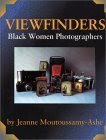
I typed those three words into google, and hey, there's a book by that name. In fact, on my 30th birthday, someone whose web name is Zingha gave the book "Viewfinders. Black Women Photographers" a five star rating on goodreads.com.
Here is what some reviewers had to say about Jeanne Moutoussamy-Ashe's book:

"...an historical perspective of the amazing Black women who were pioneers in photography. I learned about Eslanda Robeson, Elizabeth "Tex" Williams, Adine Williams, etc.-- women who inspired me (a Black woman) to become a professional photographer in a field dominated by men. The book's bio-bibliography is an added "plus" because it lists the cities where the Black women photographers resided."

"...it is a classic history of the black female participants in the field of photography, mostly journalistic or portrait photography (which I frankly prefer for the unsung aspects of history it drags with it."

As Moutoussamy-Ashe tells the story, these black women photographers have been there all along, apprenticing under the black men photographers, married to them or their daughters. As the men were elevated to a partial visibility (after HARLEM ON MY MIND at the Metropolitan in late 60s), the women never rose to attention with them.

...black photographers of whatever gender remain marginalized and underrated. Not quite sure why this is but it can be clearly perceived in looking at the present status of the two most famous African American male photographers ever-- Gordon Parks and James VanDerZee. That they are both dead after long rich lives doesn't help. Why doesn't everybody who graduates from college, black or white, know these two photographers, just as they know who Martin Luther King and Malcolm X are?

...my suspicion is that a lot of us buy books to look at and display, which we don't bother to read so that information contained therein does no good, doesn't lead to anything. People don't know anything more than when they bought the book, maybe less because now they think they've done all they can do for the good health of the black image. It's not the buying of the book that transforms. It's the reading of the book! Of course, there isn't any time these days for reading so who is to blame?
Maybe you don't dig my analysis. Nevermind. Just get this book if you can find it-- it should be in the library somewhere or weed through the second hand market-- and it will straighten you out along with Deborah Willis's history of photography with link herein.

What a gem this book is! This is certainly an area of photography unexplored by most. Though I've loved photography for decades, until I found this book I hadn't given much thought to women of color who photographed. When I think of difficulty that women such as Gilpin and Cunningham had in simply supporting themselves in the early days, how must it have been for these women, seemingly doubly handicapped!
One must respect the difficulty Mrs. Ashe encountered trying to uncover so many of the more obscure figures. My favorites were the women who operated commercial photographic studios, taking all types of 'hack' photography. Of course, we have now come to respect that type of photography as a form of documentary work, and some of these women did it beautifully. 'Tex', the military photographer, was another favorite.

So there you go, a whole lot more information coming at you, thank you online book reviewers everywhere.

Monday, March 2, 2009

Carrie Mae Weems -- Portland Native


Carrie Mae Weems' work focuses on gender and racial issues in our country. Her first body of work dealt with the journey of her family to Portland where she was born in 1953.

"My work reflects my desire to understand my ex-perience in relation to my family and my family's experience in relation to black families in this country.... I am fascinated by the distances between people in the same family, between men and women, and between ethnic groups and nationalities through the use of language derived from experience. There's a certain language that comes out of sharecropping and cotton farming, that comes out of the way men and women, women and children, and women and women share experiences. That's the vitality of language."

She has continued to push the envelope of photography producing many different series and venturing into video to produce pieces such as "Italian Dreams" in which she walks with her back to the camera through the hallways and gardens of Cinecitta. Cinicitta is the studio in Rome made famous by Freerico Fellini. Being a feminist Weems has love/hate relationship with Fellini and in the video challenges his denigration of women.

Many of Weems series reflect her anthropological and folkloric training in her academic studies. When she moved from Portland to San Francisco after high school she intended to study dance. To support herself she took jobs in the garment industry and became politically active. She received her first camera as a twenty-first birthday present and it's as if that was a prophetic gift. In 2005 she received 2005 Distinguished Photographers Award from Women In Photography International one of many awards she has received for her photography since the 1980's. Her education includes degrees from the California Institute of Arts in Valencia and the University of California in San Diego. After receiving her MFA from San Diego she entered the Graduate Program in Folklore at the University of California in Berkeley.

Her series include themes around slavery, life in Cuba, and the Changes in Beacon, New York with the emergence of DIA in that community.

Sunday, March 1, 2009

Weems' Revision of Mission Impossible Message

In this photograph Carrie Mae Weems reinterprets the well known Mission Impossible message by moving the subject 'The Mission' to the second part of the sentence and the action 'if you choose to accept it' to the beginning of the sentence. Jim is at a table, his head bathed in smoke from an unknown source, he holds a tumbler of, presumably, liquor. There is a bottle of Mouton Cadet Red wine on the table, an ashtray of cigarette butts, a phone off the hook whose cord recedes out of the picture and a tape deck. Jim is focused on the tape deck. The look on his face tells me he isn't completely sold on the idea, but that he's heard the tape. He contemplates.
The most important part of the sentence has become choosing to accept. Weems asks Jim to choose to accept, and by doing so he will accomplish the mission of landing on his own two feet. The missions set forth upon in Mission Impossible don't hold a candle to what Weems is asking Jim to do.
In the American television series of the 1960's unknown sources asked secret agents known as the impossible mission task force (IMF) to combat evil, the means by which they were to do so changed with each episode. After playing the tape, the tape deck erupted. In this photograph there is surely the notion that something will erupt.
Weems hasn't missed this opportunity to reconsider what that can mean.

Saturday, February 28, 2009

Carrie Mae Weems -- Artist Talk at Brooklyn Museum


At last the weekend and perhaps everyone will have some quiet times, time to sit and reflect. As I sit and reflect I realize that reading and experiencing Carrie Mae Weems this week has enriched my life more than I had any thought it would. Late last night, I found that the Brooklyn Art Museum is exhibiting her work through March of this year (I'll miss that by a month, my visit being in April). As part of that exhibition, the museum hosted an artist talk which they have uploaded to the web on their site as well as through iTunes. Weems is a provocative speaker, reaching in and waking up your voice, the one that speaks to you each morning, your muse. The voice that creates your practice.

For now, I'm going to share the video. It does takes time to watch and for that effort you will be rewarded with the vision of this strong woman who can open space in your life to create your own personal vision. You'll see a continuum of her practice and watch her move as she speaks. Think of it as renting an inspirational art documentary but for free, thanks to the Brooklyn Art Museum. Carrie Mae Weems said at the beginning that she sounds as if she has been a girl who gets around. She has and she shares those experiences with eloquence.

Note that there is a small screen symbol on the information line immediately below the video. Clicking on that will take you to a full screen mode.

Friday, February 27, 2009

Carrie Mae Weems - Jim and Mission Impossible


Alfred Maurer reappeared after a short hiatus, full of wonder and questions. Comments, too; we'll get to those later. We watched the Winston Marsalis and then went to sleep. This morning I thought about his reaction to "Jim". He loved the tonal qualities of the black and white. The pendant hanging above the kitchen table casts light down from a circle of brightness. The cubist in Alfred thought the well defined black triangle emphasized the circle. Floating across the middle of the image is smoke from what is probably Jim's 10th cigarette. I couldn't get Alfred to tell me if he used to smoke but he obviously understood the sense of despair that Jim must have been feeling. He remembers Harlem and figures Jim may be between jobs, between girls and looking to smoke and drink to comfort him. Alfred thought the choice of wine was a good one. He just hoped that Jim wouldn't be drinking it all at once. He also wondered what that object was in the upper right hand corner. I told him we'd head to the museum this morning and check it out. Weems' reference to mission will also come later.

For now, I'll leave you with this short video of Carrie Mae Weems' opening in NYC. The exhibit itself was quite stunning in person. Alfred was miffed he hadn't met me when I was in New York so I could take him to it. Weems' work is both stunning and informative.

Thursday, February 26, 2009

Carrie Mae Weems and Winton Marsalis

Carrie Mae Weems uses photography to display cultural mode in what reads like deeply thought out journal entries. Her world is to display not her own diary, but those of the exploited. She uses text, color, light and narrative to express the plight of African people. Winton Marsalis, in this youtube video, plays in song what Weems' pictures tell us visually. Listen to the notes. Watch Carrie Mae rise to begin a standing ovation, then watch her dance in her yellow vest. She celebrates being herself while she explores what it is to have been herself in the dominant Eurocentric mythology of the past.


We have a few of her photographs in our collection, including "Jim, if you choose to accept, the mission is to land on your own two feet" seen here.


I cannot help but to love Carrie Mae Weems.