Showing posts with label week 34 - Gustave Courbet. Show all posts

Wednesday, August 26, 2009

Courbet Finale

And here is one final self portrait of Courbet:

He has inspired me to think about my own self portrait. It takes courage to really look at yourself.
The video from yesterday was so fabulous, I hope everyone watched it- there's not a muppet out there who doesn't have the courage of Courbet.
Speaking of courage, just two weeks ago here on Fifty Two Pieces we talked about C.S. Price, another artist who used the palette knife to create his paintings. Courbet's paintings don't appear as rough as Price's. But all I've seen are web images, so it's hard to tell. If I want to see Courbet's self portrait above and others in the area I'll have to drive south the San Francsico's Fine Art Museum and check out this portrait he did of his sister:

They also have this Landscape:

Tuesday, August 25, 2009

Courbet ~ Palette Knife Wielding Artist


Gustave Courbet was not only handsome – he was also rebellious. And not just in politics as Amy mentioned yesterday. He was always looking for some way to set himself apart from others. And that included how he applied paint to the canvas. Everyone else used a brush. But Courbet at some point took the paint directly from his palette to the canvas with his knife. Others just used that knife for mixing the paints. This was a radical move on his part but led to many others to do the same – all of the moderns, including Picasso, Pollack and Richter. For an understanding of how Courbet used his palette knife and the amazing effects he could create, watch the video at the Getty website that I have linked here.

Today's image is of The Wave. You'll find that the video, A Mockumentary about Gustave Courbet, is not only educational but also an "intriguing story of the man brave enough to use a pallette knife and stand against the wave of current trends". Have fun and a banner day.

Monday, August 24, 2009

Courbet, Handsome and Political


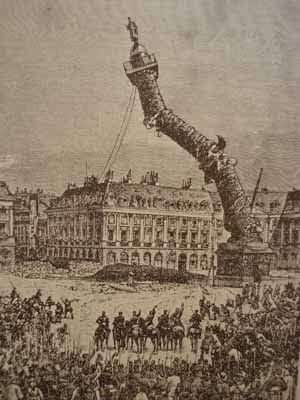
"Inasmuch as the Vendôme column is a monument devoid of all artistic value, tending to perpetuate by its expression the ideas of war and conquest of the past imperial dynasty, which are reproved by a republican nation's sentiment, citizen Courbet expresses the wish that the National Defense government will authorise him to disassemble this column."
It seemed for a moment that all that interested Courbet was Courbet, which might explain why he would take issue with a monument that celebrated Napolean. Napolean erected the column modeled after Trajans Column to celebrate the victory of Austerlitz in 1805. It is made of bronze plates taken from the cannons of the combined armies of Europe. On top sat a laurel crowned Napolean.
Courbet got involved with the Paris Commune in 1871. The commune was brought on by worker's discontent with conditions following the Franco Prussian War. A more socialist society was desired, and the Vendome Column was under attack. Courbet didn't want to destroy the column, but move it to Les Invalides, the area of Paris set aside for military history- Napolean's tomb is there.
The column was taken down, and then reassembled. Courbet was asked to pay for part of that task, and not being able to, he put himself into exile in Switzerland. This might explain why, for a man behind bars, he seems very self satisfied and content.

Sunday, August 23, 2009

Gustave Courbet ~ Self-Portraits of a Handsome Man


Much has been written about Gustave Courbet. More than a dozen books with Courbet as the main title are on the first two pages of an Amazon search with his name. Many more articles can be found by doing a Google search. Some of the most recent articles have dealt with the 2008 retrospective at the Metropolitan Museum of Art in New York. The Met had chosen to display Courbet's work thematically as opposed to chronologically. As a result the very first gallery was filled with self-portraits Courbet had painted after his arrival in Paris. Courbet was a young man searching for himself. There were so many of these portraits you could almost hear the critics of the day complaining “Courbet waving, Courbet walking…Courbet everywhere….”

Courbet painted himself as many different people. He would have us think he was in despair in The Desperate Man (shown above). Desperate is thought to have been painted shortly after he had moved to Paris to become an artist. We are seeing him at his frazzled and handsome best, somewhat like an early Johnny Depp. A similar crazed look shows up a few years later in Mad with Fear (shown below).


During that same period though Courbet portrayed himself as an artist in The Sculptor and as a game player in The Draughts Player.


Courbet with a Black Dog was accepted by the Salon in 1844 and gave Courbet the official recognition and that greatly pleased him.


Also in 1844 he painted Lovers in the Country. Here you can see Courbet with his love at the moment, dancing in the countryside.


Man with a Leather Belt shows Courbet stroking his beard with the back of his hand. His other hand is taking hold of a rather large belt buckle on his waist. Check out those bedroom eyes. Walking around a gallery with this many Courbets, you know you're being seduced into looking for more portraits. And there are more.


For example, in Le Guitarrero, Courbet painted himself as a musician. Since it seems well known that he didn't know how to play the violoncello, it's questionable if he knew how to play the guitar. The Violoncellist painted in 1847 is our piece of the week here at Fifty Two Pieces.


The Man with a Pipe shows Courbet in 1849. Here, he is looking down his nose towards his pipe but also probably at the art critics who were not always too kind.

In 1854, Courbet repainted The Wounded Man. X-rays show that Courbet painted over the image of a woman who he had been embracing.


Also in 1854 Courbet painted Bonjour Monsieur Courbet showing himself meeting with Alfred Bruyas, a wealthy collector. Much can be said about how Courbet painted himself and these other two men and their dog. However, we can say for certainty is that Courbet painted outside because he's carrying a portable easel.

One of the last self-portraits that Courbet painted is Portrait of the Artist at Sainte-Pelagie. Here Courbet is sitting in prison, smoking a pipe, wearing a beret and a red tie around his neck. Courbet had been imprisoned for his responsibility in the destruction of the Vendome column. He has a pensive look, not quite the Johnny Depp good looks and swagger from the early years.

Saturday, August 22, 2009

What Painting Is, James Elkins

In James Elkins book What Painting Is I found a description that goes so well with Courbet's Violoncellist, Elkins writes:
Paint records the most delicate gesture and the most tense. It tells whether the painter sat or stood or crouched in front of the canvas. Paint is a cast made of the painter's movements, a portrait of the painter's body and thoughts. The muddy moods of oil paints are the painter's muddy humors, and its brilliant transformations are the painter's unexpected discoveries. Painting is an unspoken and largely uncognized dialogue where paint speaks silently in masses and colors and the artist responds in moods.
Now compare the Violincellist with all its muddy moods and unexpected brilliance to this other Courbet in the European gallery, Autumn.

Autumn depicts two people on a bluff above a river under the changing leaves of a deciduous tree in fall. It has nothing of the memory of the tired body that made it, something according to Elkins you can see in great work of great artists. The painting should show the careful and nourishing gestures, the exhausted truces. Painters can sense those motions in the paint even before they notice what the painting is about, says Elkins. It reminds me very much of something Eudora Welty said about writers, that they can hear the rhythm of the next sentence coming before they know what it will be.

Friday, August 21, 2009

Gustave Courbet ~ The Violoncellist and The Cellist


Yesterday Amy mentioned that the Nationalmuseum in Stockholm owns a Violoncellist similar to the one here at the Portland Art Museum. Although remarkably alike, the one in Stockholm (shown above) does have a number of differences. First off, the title is just The Cellist. Next, you'll notice that there is no sheet music. And the overall painting is much brighter. The Cellist was painted in 1848, a year after The Violoncellist. Perhaps 1848, was a happier time for Gustave Courbet. Both are considered self-portraits and both do show Courbet holding a violoncello. Since Courbet couldn't play the instrument, we can all wonder why he chose to portray himself as a musician.

The hands in both of these portraits are expressive, almost portraits in themselves. Professor Steven Zucker from the Smarthistory project talked with Bruce Guenther, Chief Curator of the Portland Art Museum about The Violoncellist on a short video shot linked here. To the left is a close-up from Professor Zucker's photostream on Flickr. You can truly appreciate how Courbet crafted the nails, the knuckles, the fingers of that right hand.


An interesting side note about The Cellist and The Violoncellist – in 1919, the Metropolitan Museum of Art in New York mounted an exhibition in honor of Gustave Courbet 100th birthday. The Violoncellist was loaned by C. E. S. Wood, one of the founders of the Portland Art Museum, for that exhibit. In 2008, The Cellist was loaned by the Nationalmuseum in Stockholm for a major retrospective at the Metropolitan of Gustave Courbet's work. The Violoncellist stayed here in Portland. Perhaps in 2019, they'll both be hung in the same retrospective honoring Courbet's 200th birthday.

Thursday, August 20, 2009

The Violincellist by Courbet


Courbet, the French painter of the mid 19th century painted this self portrait in 1847. Courbet liked to paint himself, in this case as a musician, in other cases as a poet, a peasant, a troubadour. X-rays of this painting show that the figures position and gesture changed over the course of the painting. He didn't paint from a model, but from his mind. The musical score in the middle right of the canvas is on a different canvas altogether. There is a second Violincellist in the National Museum of Art in Stockholm, without the music and a bit smaller. The painting is above all else, dark. Looking at it in the gallery I crane my neck here and there to see more deeply into it, but the deepest place is the expression on this man's face. His hands are knotted like twigs. His eyes look right through me, what is that song he plays?